
The Test summer was barely over. The Hundred had just wrapped. Yet such is the chaos of England’s cricketing calendar that the team were already back in action. This time against South Africa. Blitzed in the first ODI. Close in the second. Resoundingly victorious in the third. And yet, England fell to familiar white-ball cricket series defeat.
The T20s were a little better. Initially, there was little to learn from the 5 over, rain hampered, defeat in Cardiff. Yet, in Manchester, England stormed to 304-2, a record score against a test playing nation and a glimpse of this young side’s destructive potential. The final T20, played in mid-September, was frustratingly rained off, another damning indictment of the current state of the cricketing calendar.
It doesn’t feel long ago that this team were winning World Cups. An ODI crown in 2019 and the T20 title in 2022 capped a period of English white-ball dominance. So what has changed? Are we seeing a slump in the white-ball game as focus shifts to the tests? Or are England building something that will see them challenge in the upcoming T20 World Cup next year?

Two World Cups and One in Seventeen
Cast your mind back to 2019. Under Eoin Morgan’s leadership, England had reinvented their white-ball cricket and reached the pinnacle by winning the World Cup. In a summer of great cricket, the final delivered one of the greatest games of all time. A low scoring thriller decided only by boundary count after a super over; to the annoyance of everyone except England fans. Three years later, under Jos Buttler’s captaincy, England triumphed again, lifting the T20 World Cup at the MCG.
Before Eoin Morgan became England captain, their white-ball record was abysmal. In the 2015 ODI World Cup, they hit the joint fewest sixes and were knocked out in the group stage. Morgan aimed to transform England’s approach to white-ball cricket. He demanded attacking, aggressive play and filled his team with players who could deliver it. England began to approach white-ball selection much as they do (sometimes frustratingly) the Ashes. The question shifted from ‘Who is the best option for this game?’ to ‘Who will be the best option for the next tournament?’. In addition to that, England selected players on their ability to dominate in Morgan’s ideal style of play. The success that followed was there for all to see.
Yet, while England ruled the white-ball world, their red-ball fortunes told a very different story. In Tests, inconsistency and fragile batting highlighted a team struggling to keep pace with their shorter-format success. The years following England’s white-ball success were plagued by red-ball misery. In 2021 – 2022 BB (Before Bazball), England’s test team went on their joint worst run of all time, losing 5 series in a row (not counting the delayed test against India played in 2023). After winning the first test in India in early 2021, England went on to win just 1 test in 17. Meanwhile, England’s white-ball side was on fire, winning 10 of 13 ODIs and 11 of 17 T20s.

England’s Superior white-ball record during the red-ball disaster.
You can’t have your cake and eat it.
Come mid 2022, the situation in the red-ball game was untenable. Captain Root stepped down, as did coach Silverwood, and so came Ben and Baz. Immediately with the introduction of Stokes, the ECB language and narrative switched towards red-ball cricket. When Stokes was appointed, ECB Managing Director Rob Key remarked when asked about Stokes’ white-ball future:
“There will be times when he does [play less white-ball cricket], no doubt about that. We’ve got to at time prioritise where he needs to be playing – obviously at the moment that will be test cricket.”
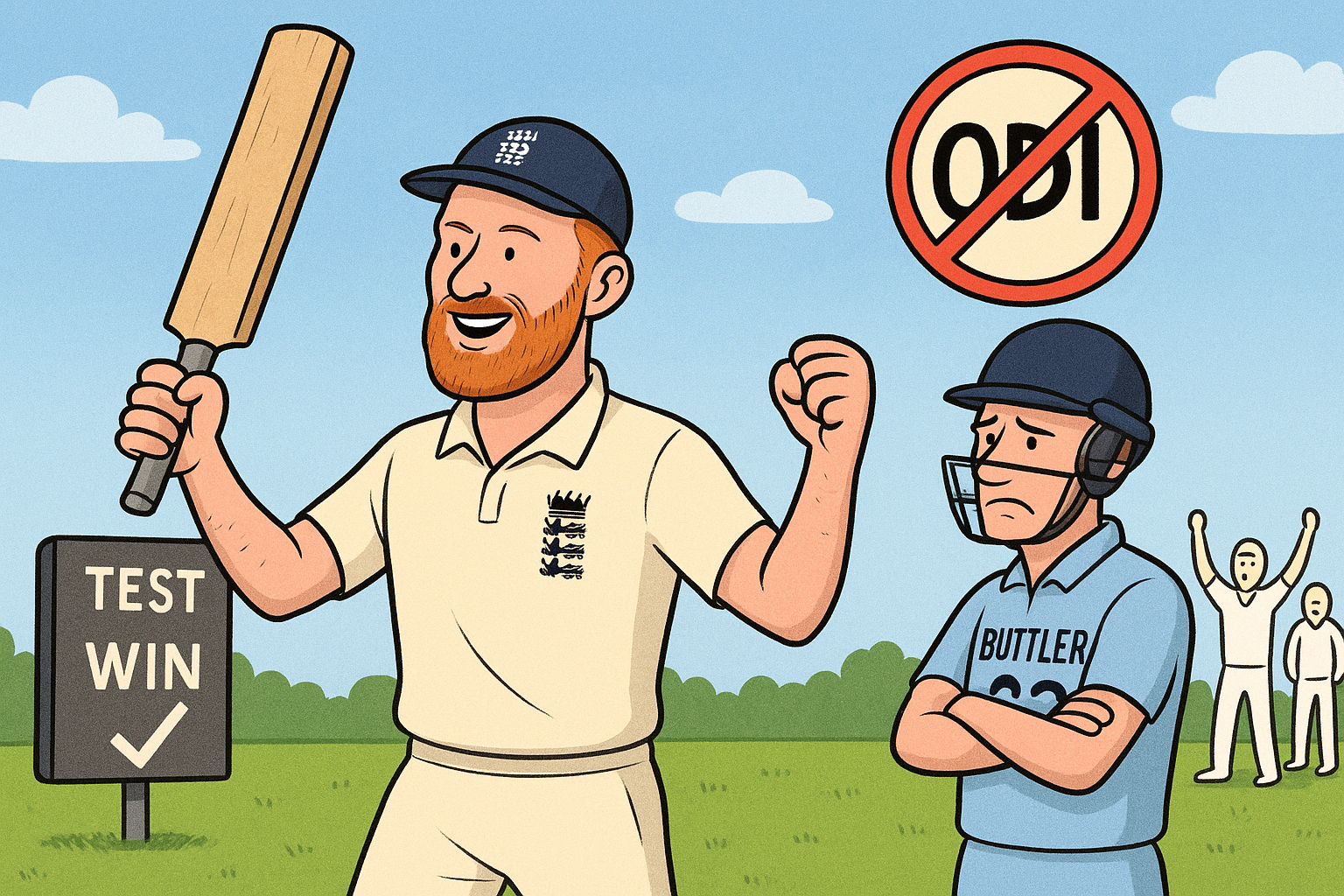
Along followed Stokes’ retirement from the white-ball game. His last appearance in T20 and ODI games came in 2022 and 2023 respectively. In fact, throughout 2023 and 2024, white-ball cricket was shunned in order to fuel the test revitalisation under Baz and Ben. In 2024, England competed in 4 ODI series, losing all 4. Simultaneously, England won 2 of their 3 test series, with the loss coming away to India. Buttler’s captaincy saw England win one World Cup. However, the three tournaments that followed led to sorry exits, drawing the curtain on his time as captain.
Englands shift in focus away from the white-ball game, in particular ODIs, is evident. The stark contrast in appearances made by England’s 2019 world cup winners pre and post 2019 highlights this shift.

This trend continued in 2023 and 2024, with Buttler often missing his best players as they prioritised Test cricket. Meanwhile, the domestic one-day game has suffered under the increasingly congested schedule. The One Day Cup, England’s premier one day competition for over 60 years, now runs in conjunction with The Hundred. Resultantly, it has been reduced to a platform for blooding youngsters, with senior players choosing more lucrative, franchise tournaments. In recent years, England’s cricketers simply haven’t played enough one-day cricket.
The ECBrook
The solution for England’s recent troubles in the white-ball game appears to be similar to their solution for reversing their test match form. It involves choosing a team for a future tournament, and backing those players to deliver with consistency in selection. Perhaps nobody demonstrates the England hierarchy’s commitment to continuity more than Harry Brook and Jacob Bethell.
Harry Brook embodies continuity through the sheer number of games he’s played this summer. Now captain of the white-ball sides, Brook’s has had one of the most demanding schedules of any player in world cricket. Before the Ireland series, Brook played every game, in every format, that England played in this year. Brook is the only player to manage this feat, testament not just to his fitness and skill, but also to his determination to embed his philosophy into the white-ball teams he has inherited. Whilst, fellow all format players like, Duckett, Smith and Archer rested, Brook ploughed on, with his last innings an unbeaten 41 in England’s record breaking 304-2 T20 score. When quizzed on tiredness and the potential need for rest Brook said the following:
“We want to try and play our strongest side in every white-ball game. We have World Cups coming up – the T20 World Cup this winter and the one-day world cup the following winter.”
England’s management is already shifting into World Cup preparation mode, and for good reason. In the ODI series against South Africa, they went in with almost no preparation: The Hundred ended on August 31, and just two days later, England were thrown into the first ODI. By contrast, South Africa had played a full three-match series against Australia in August. The result was initially disastrous, with England bowled out for just 131 a score chased down within 21 overs. Yet by the final ODI, England had responded emphatically, winning by 342 runs, the largest margin of victory in ODI history.
Clearly, England play better cricket when they are allowed to settle into a series and put faith in the players they believe in. Despite cricket being a highly individual game, consistency in selection allows for the development of partnerships with both bat and ball. It also gives a young England side the perfect environment to learn the strategic ins and outs of limited-overs formats, from constructing an innings to bowling under pressure.
Betting on Bethell
This brings us onto, Jacob Bethell. Whilst Brook embodies continuity through appearances, Bethell embodies it through the faith selectors have shown him, despite mixed returns. By his own admission, Bethell hasn’t played enough cricket this year, leading to him looking like a rabbit in the headlights in the final India test. Before the South Africa series Bethell hadn’t even scored a professional hundred. The ECB response? Name Bethell as captain for the Ireland series. This faith isn’t a new trait for the ECB. Zak Crawley is a shoe-in opener for the test side despite only averaging 31. Meanwhile, this week McCullum confirmed Shoaib Bashir as England’s first-choice spinner for the Ashes. That sense of continuity has served the Test side well, with England’s record improving markedly under McCullum’s leadership.
Bethell, for his part, has begun to repay the faith shown in him, scoring his first hundred in a sublime knock against South Africa and winning his first game as captain against Ireland. Yet questions still remain. Jamie Smith is a batsman England like at the top of the order, yet Phil Salt is in sublime form. Salt has recently achieved the small feat of a 39-ball 100 against South Africa and an 89 (46) against Ireland. Will England back Salt, the man in form, to open in the World Cup and reintegrate him into the ODI setup? Or will they return to Jamie Smith, a player they clearly see as having a huge role in the future of English cricket?
For the white-ball team, the real examinations lie in the World Cups to come. For McCullum, success is rooted in trust: a culture where players refuse to fear failure and instead seize opportunity. England have followed a selection policy that rewards players that adhere to this. The side that opens for England in the World Cup will be revealing of how the selectors balance form against ceiling.
The Battles that Lie Ahead
For a team not to long ago defined by white-ball dominance, England’s recent struggles are a necessary consequence of prioritising red-ball success. Yet, as the Test team’s journey culminates in Australia this winter, the focus will shift to a T20 world cup on the sub-continent. This summer has delivered more questions than answers: a team at times scintillating and record-breaking, at others dismal and outclassed. The English selectors have bet on continuity, an approach that has served their Test side well, hoping it can birth a new white ball juggernaut. The red-ball experiment is reaching its climax, but for the white-ball team, the journey is just beginning. First stop: India.